Saturday, July 20, 2019

Ranthambore Tour Operator | Ranthambore Tour Planner


Ranthambore National Park or Ranthambore is the fortieth largest national park in northern India, covering 392 km². Ranthambhore was established as the Sawai Madhopur Game Sanctuary in 1955 by the Government of India and was declared one of the Project Tiger reserves in 1973. Ranthambhore became a national park in 1980. In 1984, the adjacent forests were declared the Sawai Man Singh Sanctuary and Keladevi Sanctuary, and in 1991 the tiger reserve was enlarged to include the Sawai Man Singh and Keladevi sanctuaries.
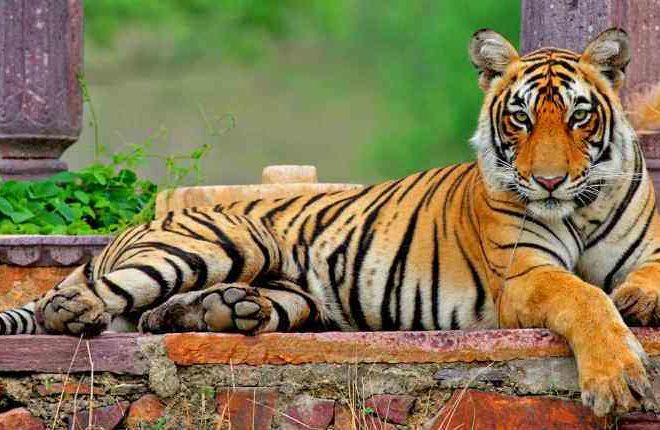
Image result for ranthambore Rajasthan

Ranthambore wildlife sanctuary is known for its Bengal tigers, and is a popular place in India to see these animals in their natural jungle habitat. Tigers can be easily spotted even in the daytime. The best times for tiger sightings at Ranthambore National Park are deemed to be in November and May. The park's deciduous forests are characteristic examples of the type of jungle found in Central India. Other fauna include the Indian leopard, nilgai, wild boar, sambar, striped hyena, sloth bear, southern plains gray langur, rhesus macaque, mugger crocodile and chital. The sanctuary is home to a wide variety of trees, plants, birds and reptiles, as well as one of the largest banyan trees in India.


Ranthambore Fort - The noteworthy Ranthambore Fort was built by the Chauhan rulers in the 10th century. Due to its strategic location, it was ideal to keep the enemy at bay. The fort is also related to the historical legend of the royal women performing ‘jauhar’ (self-immolation) when the Muslim invader Alauddin Khilji laid siege on this fort in 1303. The fort is characterised by temples, tanks, massive gates and huge walls.
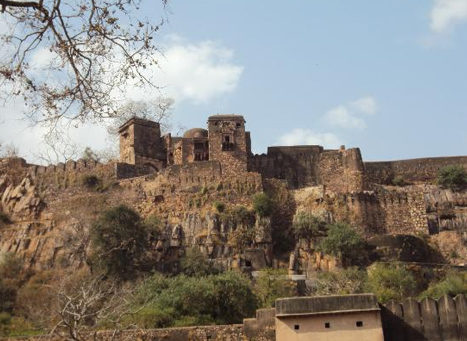
Image result for ranthambore Fort

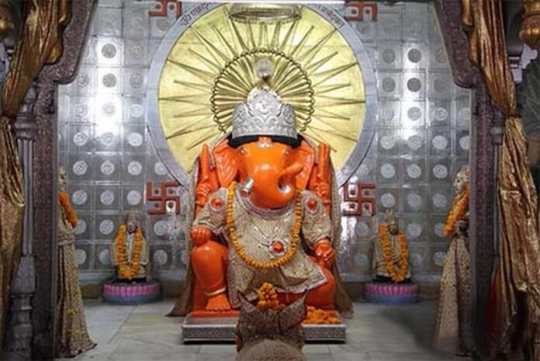
Trinetra Ganesha Temple – Ranthambore Ganesh ji is very old temple on the palace of Ranthambore fort. It is very heart touch place for devotee and visitors. Ranthambore Ganesh Temple dedicated to Lord Ganesha is located in the fort of Ranthambore, about 12 kms from Sawai Madhopur It is said that; in 1299 AD, there was a war between King Hammeer and Alauddin Khilji. During the time of war they filled there godowns with foods and all the necessary things in Ranthambhore Fort, where King resides. Since the war lasted for several years, the stock in godowns were over.
One night when King Hammer; who was a great devotee to God Ganesh, was sleeping, he dreamed that Lord Ganesh came to him and said that by tomorrow morning all the problems and lacking would be over. In the morning an idol of Lord Ganesh with three eyes*(Trinetra), embossed from one of the fort’s wall. As a miracle the war was over and the godowns were full. In 1300 AD King Hammer built a temple of Lord Ganesh and placed Riddhi Siddhi, his wife and two sons Shub Labh along with the idol of Ganesh. His vehicle mushak (mouse) is also placed there. Ganesh Chaturthi holds a special place in Ranthambore and is celebrated to commemorate the origin of Lord Ganesh, who is said to have been born on this day. The Ganesha temple in the fort of Ranthambore is one of the most eminent Ganesha temples of Rajasthan.


Surwal Lake - Surwal Lake, a beautiful seasonal lake, is situated at about 25 km away from Ranthambore. The lake is heaven for a variety of birds. Travellers are mesmerised and captivated by the beauty of this lake, especially, during the months from November to March. Surwal Lake is another popular tourist destination, which offers beautiful view of flora and fauna in Ranthambore.  This lake is situated at a distance of 25 km from Ranthambore. The ideal time to visit this place is during the months of November to March, when nature presents beauty at its best. During winters, many migrated birds can be seen at this lake. Plenty of birds which can be witnessed by visitors are demoiselle cranes, pelicans and many others. The place is mostly frequented by nature lovers, who can enjoy sunrise and sunset along with the chirping of birds. Tourists should avoid visiting this place in the months of April and May because there is no water in the lake.
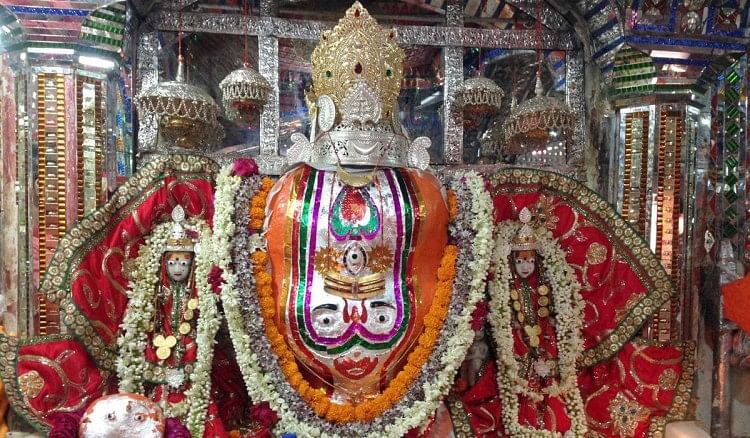
Image result for Trinetra ganesh Temple

Padam Talao - The famous Ranthambore National Park is home to one of the largest lake around this place named as Padam Talao. The name of this lake comes from the lotus flower (called as Padam in Hindi language) that grows readily here. It is a major source of water for animals and birds living in this national park. It is one of the prominent places where tourists can watch different wildlife animals as they often come here to quench their thirst. Wildlife lovers can climb the machans that are built around this lake and watch the wild inhabitants of this park closely.

Kachida Valley - Kachida Valley is situated in the outskirts of the Ranthambore National Park. The valley treasures an array of flora and fauna. A majority of the panther population of the park is found here.  Tourists can also witness sloth bears and deer in this part of the park. Travellers can hire Safari Jeeps to tour and enjoy the beauty of Kachida Valley. Kachida Valley is one of the picturesque and a must-visit place in Ranthambore. It is blessed with wide range of flora and fauna species. This area contains a majority of the Panther population of the park. The Panthers avoid venturing into the main jungle to avoid conflicts with tigers, which are known to kill them. Tourists can also see a variety of sloth bears and deer in this valley. Visitors will have to reach this valley via the jeep safari.

Image result for Kachida Valley


Jogi Mahal -The Jogi Mahal, an elegant guest house at the foothills of the Ranthambore, was built by the royal families of Jaipur. It served as their hunting lodge for many generations. This forest guest house provides all modern facilities to the visitors.ranthambore tour packages Jogi Mahal is a favorite watering hole of the animals of Ranthambore. Tigers, Leopards, Deer, Monkeys and Peacocks can be seen drinking at the lakes edge during the early morning and late evening. Machans or huts on observation posts near the Padam Talao are an excellent platform from where visitors can see the animals in their natural habitat. Genghis, one of the legendary tigers of Ranthambore was famous for hunting deer that came to the lakeside to drink. The hunting lodge called Jogi Mahal is situated on the banks of the Padam Talao. The view from the Jogi Mahal is a splendid one. Jogi Mahal was built by the royal families of Jaipur and served as a hunting abode to various generations of Jaipur Maharajas. After the decline of ruling authorities of Jaipur, this Mahal is turned into a guest house which offers comfortable stay to tourists during their visit to Ranthambore.

Raj Bagh Ruins - Raj Bagh Ruins are an agglomeration of prehistoric ruins including arches, palace outhouses, domes and minarets. This place lies between the Raj Bagh Talao and the Padam Talao. The Rajbagh ruins located along the banks of the lake add to its exotic ambience. The ruins of these structures consist of broken down rooms and outhouses with arches, partly standing walls and domes. The majestic tigers of Ranthambore can be seen relaxing in the shade of these structures in Ranthambore National Park. These ruins are what give the Ranthambore National Park such a unique mixture of a wildlife reserve and a reminder of the past, which together make it one of the most picturesque parks in the world.

Image result for Raj Bagh Ruins

Malik Talao - Malik Talao is best known as a haven for birds and it attracts a large number of visitors. The lake is quite important to the wildlife of the park as it serves as the source of water and food for the animals and birds inhabited there. This small yet scenic lake is also home to the Marsh Crocodiles. Herds of wild boar and groups of peacocks, eagles and various migrated birds can be seen browsing along the banks of the lake.ranthambore tour packages Kingfishers, egrets, herons, ibis, storks and cranes are some of the commonly spotted birds at Malik Talao making it the perfect place for bird watching in Ranthambore. Malik Talao is one of the lakes present in the Ranthambore National Park. These water bodies are vital for the ecosystem of the park as they act as a source of food and water for birds and animals. The lake attracts a large bird population that includes plovers, moorhens, herons, storks, kingfishers, kites and hawks. Crocodiles can also be seen resting on the banks while, at times, tigers are seen too.


Friday, July 19, 2019

Jaipur Tour Operator "The Pink City of Rajasthan India"


Jaipur “Pink City” - Jaipur is the capital of India’s Rajasthan state. It evokes the royal family that once ruled the region and that, in 1727, founded what is now called the Old City, or “Pink City” for its trademark building color. At the center of its stately street grid (notable in India) stands the opulent, colonnaded City Palace complex. With gardens, courtyards and museums, part of it is still a royal residence.

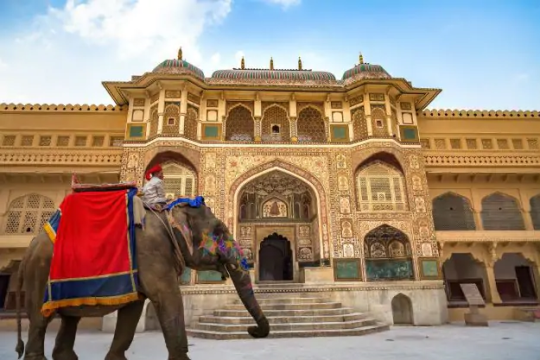
Amber Fort - Amber (pronounced Amer) is at a distance of about 11 kilometres from Jaipur. Now a UNESCO World Heritage Site, it was the bastion of the Kachwahas of Amber, until the capital was moved to the plains, to what is today Jaipur. The palace, located in craggy hills, is a beautiful melange of Hindu and Mughal styles. Raja Man Singh I began construction in 1592 and the palace, which was built as a strong, safe haven against attacking enemies, was completed by Mirja Raja Jai Singh. The contrast between the harsh exterior and the inviting interior couldn’t be more surprising. Made entirely of red sandstone and white marble, visitors are left spellbound by the magnificence of the palace that utilises carvings, precious stones and mirrors. The splendour of the palace is enhanced by the breath-taking vista of the Maota Lake in front. The palace is nearly seven centuries old and has a legendary past. Originally a small structure that the Rajputs won from the Meena tribes, it was later transformed into the grand Amber Palace.


City Palace - Located deep within the walled city, the City Palace Complex was conceived and built by Maharaja Sawai Jai Singh II, the founder of Jaipur. A beautiful fusion of Mughal and Rajput architecture, the palace is still home to the last ruling royal family which lives in a private section of the palace. Maharaja Sawai Jai Singh II is credited with building most of the structures, but it was expanded upon by later rulers as well. The City Palace Complex includes the Mubarak Mahal (the palace of reception) and the Maharani’s Palace (the palace of the queen). Mubarak Mahal now houses the Maharaja Sawai Man Singh II Museum and displays a vast and unique collection of royal costumes, delicate Pashmina (Kashmiri) shawls, Benaras silk saris, and other dresses with Sanganeri prints and folk embroidery. The clothes of Maharaja Sawai Madho Singh I are also on display. The Maharani's Palace, surprisingly, has an interesting display of very well-preserved Rajput weaponry, some dating back to the 15th century. Other than the arms, the palace is adorned with beautiful paintings on the ceiling that are well-maintained.

Jantar Mantar - Now a UNESCO World Heritage Site, Jantar Mantar in Jaipur is considered to be the largest of the five astronomical observatories built by Maharaja Sawai Jai Singh II, the founder of Jaipur. It contains sixteen geometric devices, designed to measure time, track celestial bodies and observe the orbits of the planets around the sun. It also houses the Interpretation Centre that helps the tourists to understand about the working principles & chronology of the observatory.

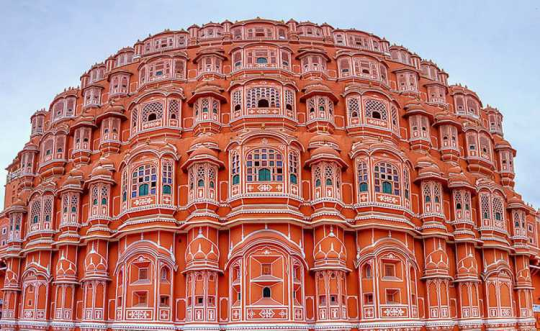
Hawa Mahal - Hawa Mahal, literally the Palace of Winds, was built in 1799 by the poet king Sawai Pratap Singh as a summer retreat for him and his family. It also served as a place where the ladies of the royal household could observe everyday life without being seen themselves. This unique five-storey structure is a blend of Hindu and Islamic architecture, and the exterior, with its small latticed windows (called jharokhas), resembles the crown of Lord Krishna. The windows also serve as an air-conditioner of sorts, blowing cool air throughout the palace, making it the perfect retreat during summers. Built from pink sandstone, the Hawa Mahal is Jaipur’s iconic landmark and visitors can view its complete magnificence from outside, from across the road. However, it is also possible to climb right up to the top for a wonderful view from the windows. Today, the Mahal is maintained by the Archaeological Department of the Government of Rajasthan and also houses an archaeological museum in the courtyard.


Albert Hall Museum - The building gets its name from The Victoria and Albert Museum in London, the inspiration for its design. The exquisitely built Albert Hall is housed in the centre of Ram Niwas Garden. Sir Swinton Jacob (who is also the mastermind behind many other palaces in Rajasthan) conceptualised and designed it using styles from the Indo-Sarcenic architecture and the Prince of Wales laid the foundation stone of the building in 1876. The museum displays a wide range of metal objects, wood crafts, carpets, stone and metal sculptures, arms and weapons, natural stones and ivory goods. It also houses a large collection of miniatures from Bundi, Kota, Kishangarh, Udaipur and Jaipur schools of art.

Nahargarh Fort - Nahargarh Fort sits proudly on a ridge of the Aravalli Hills, creating an impressive northern backdrop to the city of Jaipur. It was constructed during the reign of Jai Singh in 1734, and was later expanded in 1868. Nahargarh, which means abode of tigers, was a formidable barrier, defending Jaipur against attacking enemies. Within its walls, the fort houses Madhavendra Bhawan, the summer destination for the members of the royal family. Built by Sawai Madho Singh, the palace has 12 matching boudoirs for the queens, at the head of which is a suite for the king. They are all connected by corridors decorated with delicate murals. Even today the palace is a favoured spot for local picnickers. The fort looks brilliant when floodlit at night. Overlooking the city, it presents a glittering view of the city lights.

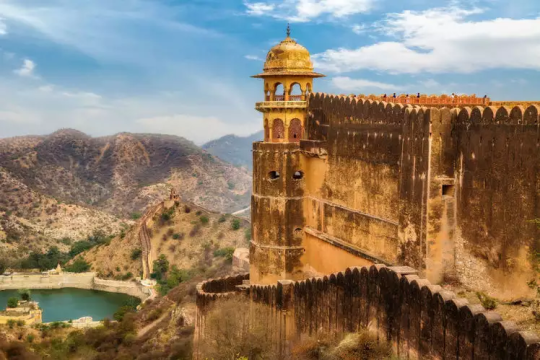
Jaigarh Fort - About 15 kilometres from Jaipur, Jaigarh Fort was built by Sawai Jai Singh II sometime in the early 18th century amidst the arid, rocky and thorn-scrub covered hills. Despite its ancient construction, it still retains most of its imposing citadel appearance. Visitors can see the world’s largest cannon – Jaiban, at the fort.


Birla Mandir - The Lakshmi-Narayan Temple, or the Birla Temple, as it is more popularly known as, is located at the base of Moti Dungari. Built on an elevated platform, this comparatively modern temple is built entirely of white marble and dominates the skyline of south Jaipur. The temple was commissioned and built by renowned Indian industrialists, the Birlas, in 1988. The temple is dedicated to Lord Vishnu, also called Narayan, and his companion, Lakshmi, the Goddess of wealth and good fortune. The temple is a work of art and has a marvellous display of exquisite carvings and sculptures covering many mythological themes. The eye is drawn to the images of Laxmi and Narayan, carved as they are, from one piece of marble. The top of the temple has three domes, each representing the three religions followed in India. This is designed to pay homage to secular India. The temple looks spectacular at night when it is lit up. Other than the main temple, the complex has a museum that exhibits the earlier belongings of the Birla family.

Jal Mahal - One of the most wonderful sights in Jaipur is the beautiful Jal Mahal or Lake Palace. The light, sand coloured stone walls and the deep blue of the water make for a wonderful contrast. The palace appears to float in the centre of Man Sagar Lake, where its magnificent exteriors can be enjoyed by tourists.

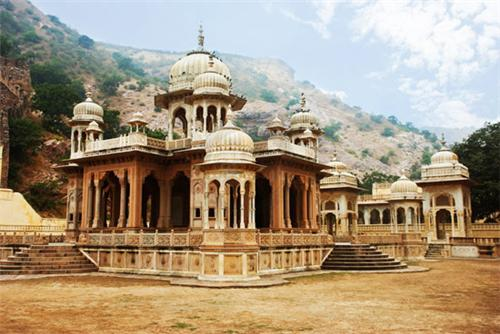
Gaitore Jaipur - Gaitore, one of the most prominent tourist attractions in Jaipur, is a royal cremation ground for the Kachhwaha Rajput kings and the members of the royal family. The word 'Gaitore' is believed to be a mispronounced form of the Hindi phrase, 'Gaye ka Thor' which means 'resting place of the departed souls'. Located on a narrow valley on Jaipur-Amer road, this place is 15 km away from Jaipur. The valley has cenotaphs (chhatri) made of marble and sandstone with Rajastani carvings, dedicated to legendary kings who ruled Jaipur. A perfect blending of Islamic and Hindu temple architecture, Gaitore has cenotaphs of Sawai Ram Singh, Sawai Madho Singh and Maharaja Sawai Jai Singh II and so on. Among these kings, the cenotaph of Maharaja Sawai Jai Singh II is quite impressive with its intricate peacock carvings and designs on beautiful white marble structure. It is said that the carvings on each cenotaph reflects the taste of the respective king. Read further to know more about Gaitore and its historic significance.


Sisodia Rani Palace and Garden – Sisodia Rani Palace and Garden is located 8 kilometres from Jaipur on the Agra road. Laid out in Mughal style, it is painted with the legends of Radha and Krishna. The garden is multi-tiered and has fountains, water courses and painted pavilions. Maharaja Sawai Jai Singh II built it for his Sisodia queen.

Govind Dev Ji Temple – The Krishna temple is a rare spire-less temple and houses the idol of Govind Devji that Sawai Jai Singh brought from Vrindavan. The deity, worshipped by the erstwhile royal family, is also revered by the the locals in the area.

Moti Dungri Ganesh Temple – Moti Doongri is a small hill around which the city of Jaipur flourishes. Moti Doongri means pearl hill, because the hill indeed resembles a pearl drop. Visitors go there to pay homage at the famous Ganesh temple, the most auspicious and important religious temple in Jaipur. The Ganesh temple was built by Seth Jai Ram Paliwal, sometime in the early 18th century. A legend goes, the King of Mewar was heading back to his palace after a long journey and was carting a massive Ganesh idol on a bullock cart. The king had decided that he would build a temple for the idol of Lord Ganesh wherever the bullock cart stopped. Apparently the cart stopped at the foot of the Moti Doongri, which is where the temple is situated today. The hill also has an exotic palace perched right on top. A replica of a Scottish castle, it was once the royal home of Maharaja Sawai Man Singh. It continues to belong to the royal family. The mere view of this castle is extremely exotic.


Digamber Jain Mandir – The ancient Digamber Jain temple at Jaipur is in Sanganer, 14 km from the city. The principal idol in the Sanghiji Temple is of Lord Adinath in the Padmasan (lotus position) posture. The temple is made of red stone and has attractive carvings. The seven-storied temple has sky-high 'shikharas' (spires) and its inner sanctum is a stone shrine with eight sky-high shikharas.

Galtaji Temple – Galtaji is an ancient pilgrimage centre in Jaipur. Set amidst low hills and packed with locals and tourists alike, the attractive spot has temples, pavilions and holy kunds (natural springs and water tanks). Visitors to Galtaji will come across the complex of Ramgopalji temple, locally called the Monkey temple (Galwar Bagh). It gets this moniker because of a large group of resident monkeys. The green landscape and chattering monkeys add to the delight of the area. On top of the hill is a small temple dedicated to the sun god, called the Surya Mandir. Constructed by Diwan Kriparam, the temple can be seen from anywhere in the city.

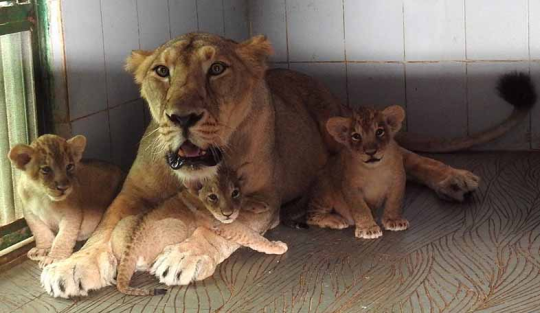
Nahargarh Biological Park – Nahargarh Biological Park, a part of the Nahargarh sanctuary is located about 12 km from Jaipur on the Jaipur-Delhi highway. It encompasses a large area of 720 hectares and is situated under the Aravalli range. The Park is famous for its vast flora and fauna, and its main aim is to conserve it. It also doubles up as a great place to educate people and conduct research on existing flora and fauna. At Nahargarh Biological Park, ornithologists can expect to see over 285 species of birds, of which, the most popular is the white-naped tit, which can only be found here. When you visit the Park, make sure you also head to Ram Sagar, which is a famous among bird watchers and makes for a great spot to catch different varieties of birds. While here, you can stay at well-equipped and famous places such as Ganga Vilas, Gopal Vilas and Lalit Vilas, which were famous with the maharajas of the yore as hunting lodges. The Nahargarh Zoological Park is also worth a visit and houses animals such as Asiatic lions, Bengal tigers, panthers, hyenas, wolves, deer, crocodiles, sloth bear, Himalayan black bear, wild boar, etc.


Jaipur Wax Museum – Amidst the confines of the Nahargarh Fort at the foothills of the Aravallis lies the Jaipur wax museum, a visit of which is sure to leave you awe-struck! It has been developed by Entertainment 7 Ventures Pvt Ltd. Hosting over 30 wax statues of famed personalities, the museum is a spectacle to behold! The wax museum, as the name suggests, holds wax statues of many leading personalities such as Amitabh Bachchan, Mahatma Gandhi, Bhagat Singh, Rabindranath Tagore, Albert Einstein, Michael Jackson, Sawai Jai Singh II, Maharani Gayatri Devi and many Indian and International leads. The life-like replicas along with detailed backdrops and ingenious sets provide an overwhelming yet unique experience. The museum also has a display of the 10 foot long Bullet, Gati Gamini, the signature Rajasthan Tourism Motorbike. The timing for the wax museum and sheesh Mahal is from 10 am to 6.30 pm and open all days of the week, The ticket price per person for wax museum and Sheesh Mahal is Rs 500 for Indians, and Combo entry for International Travellers is Rs 700 for all days.

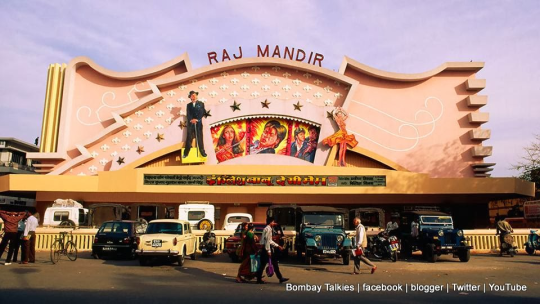
Raj Mandir Cinema – One of the most famous spots in Jaipur is the Raj Mandir Cinema. A single-screen experience, done up with a royal and luxurious architecture, the cinema holds a special place in the Pink City. Watching a Hindi movie is an amazing experience at this cinema, and booking your seat in advance is always a good idea. It was established in 1976. An asymmetrical exterior design helps the theater stand apart. Inside, the extravagantly finished roof, grand chandeliers, and a rising staircase next to the lobby lend an old world charm to the place.Located just off MI road, a Jaipur trip cannot be considered complete without a visit to the Raj Mandir.


Rajasthan Tourism

Rajasthan Attractions

Rajasthan Tour Packages

Rajasthan Luxury Tours

Jaipur Attractions 

Tuesday, May 7, 2019

HISTORY OF Ajabgarh and Bhangarh Alwar Rajasthan


HISTORY OF AJABGARH AND BHANGARH
                                   
Ajabgarh & Bhangarh  is a ruined town in the Alwar district of the state of Rajasthan, India, most famous for its historical ruins. It is said to be a haunted place. Archaeological Survey of India (ASI) has put up a signboard by the main gate stating (among others): "Entering the borders of Bhangarh before sunrise and after sunset is strictly prohibited." The reason for this may be that there can be wild animals and it could be unsafe because there is no artificial lighting. Bhangarh is at the edge of the Sariska Tiger Reserve.

Bhangarh is a place between Jaipur and Delhi in Rajasthan state of India. Bhangarh is known for its ruins, but still worth a visit; the place is beautiful and tranquil. What remains though, is a shadow of a once beautiful kingdom.
Passing by Bhangarh, banyans and temples dot the landscape and one chhatri can be seen up on the hill. The most remarkable are the temples of Gopinath, Shiva (Someshwar), Mangla Devi and Keshava Rai. Other more or less preserved buildings are e.g. shops along the main road, several havelis, a mosque, and a palace. The palace was protected by two inner fortifications across the valley. The town is separated from the plain by ramparts with five gates. Bhangarh is also a pre-historic site.

This town was established in 1573 (VS 1631) during the rule of Raja Bhagwant Das as the residence of his second son Madho Singh. Madho Singh was younger brother of Emperor Akbar’s General Man Singh I of Amber. Madho Singh participated in many campaigns with his father and brother. The next ruler of Bhangarh was his son Chhatr Singh. Bhangarh slowly declined after Chhatr Singh's violent death in 1630. Near Ajabgarh was founded by Ajab Singh, the son of Chhatr Singh. When Mughal Empire became weaker after the death of Aurangzeb, Jai Singh II attached Bhangarh to his state by force in 1720. After this Bhangarh diminished in population, and when the famine of 1783   fell on the land the town was abandoned, and has remained a ruin ever since.
It is said that the city of Bhangarh was cursed by the Guru Balu Nath, causing the towns evacuation. Balu Nath sanctioned the establishment of the town but said: "The moment the shadows of your palaces touch me, the city shall be no more!" Ignorant of such foreboding, one ambitious descendant raised the palace to such a height that its shadowed Balu Nath's forbidden retreat and thus the town was devastated as prophesied. The small samādhi where Balu Nath is said to lie buried is still there.
The other myth is as follows: The charm of princess of Bhangarh Ratnavati was said to be matchless in all of Rajasthan. Being eighteen years old, the princess started getting matrimonial offers from other states. In the same region there lived a tantrik, a magician well versed in the occult, named Singhia who was desperately in love with the princess knowing that he would never be allowed to even see her, let alone meet her. One day, he saw the princess' maid in the market buying scented oil for her. Seeing this, he got an idea by which he could meet the princess. He used his black magic and put a spell on the oil which would hypnotize the princess by her merely touching the oil, and she would surrender herself. The princess foiled this plan though. She had seen the tantrik enchanting the oil, and she therefore threw it away, whereupon the flagon rolled over a stone. As soon as the oil touched the stone, it started rolling towards the wicked tantrik and crushed him. While dying, Singhia cursed the palace with the death of all who dwelt in it, without any rebirth in their destinies. The very next year there.

#Rajasthancarrental #Hotelaccommodationjaipur
#Rajasthantrippackage #Travelindia 

Friday, May 3, 2019

Sunset Point Mount Abu Rajasthan


Top Most Attractions in Mount Abu


Dilwara temples :- The Dilwara temples of India are located about 2½ kilometres from Mount Abu, Rajasthan's only hill station. These Jain temples were built by Vastapul Tejpal , a Jain laymen between the 11th and 13th centuries AD and are world-famous for their stunning use of marble. The five legendary marble temples of Dilwara are a sacred pilgrimage place of the Jains. Some consider them to be one of the most beautiful Jain pilgrimage sites in the world. The marble temples have an opulent entranceway, the simplicity in architecture reflecting Jain values like honesty and frugality. The temples are in the midst of a range of forested hills. A high wall shrouds the temple complex.  Although the Jains built some beautiful temples at other places in Rajasthan, some believe that none come close to these in terms of architectural perfection. The ornamental detail spreading over the minutely carved ceilings, doorways, pillars and panels is simply marvellous.  Facilities are available for bathing, which is mandatory before puja is performed for the idols. These facilities use passive solar power to heat up the water for bathing and other things. Guided tour hours for tourists are posted outside the temple.

Guru Shikhar :- Guru Shikhar Peak is the highest mount peak in the Aravalli region and is at a distance of 15 km from Mount Abu. It is situated at a height of 1722 meters. Travellers can enjoy a bird view of the entire Aravalli range of mountains, from the top of this mountain peak. Temple of Dattatreya is one of the main attraction at Guru Shikhar peak other than scenic views. Dattatreya is known to be the incarnation of Lord Vishnu. A huge bell suspended from a wooden frame having an incription of 1411 AD can be seen at the entrance of the temple. This peak also named after Guru Dattatreya and a rock in a cave also sanctified his footprints. Nearby temple of Guru Dattatreya’s mother is also a major attraction for devotees. Located at 14 km from Mount Abu city one can travel to Guru Shikhar by taking Guru Shikhar Rd after Oriya Rd. Just a half a kilometer distance there is an Gurushikhar visible-Infrared Observatory which in-houses a 1.2 m infrared telescope. Here astronomical experiments continously takes place.

Achalgarh Fort :- Achalgarh fort situated about 11 kilometers north of Mount Abu, the only hill station in Rajasthan. The fort was originally built by the Paramara dynasty rulers and rebuilt, modernized and named as Achalgarh by Maharana Kumbha in 1452 one of the several forts built during his period in the rule. Achalgarh fort area is entirely surrounded by Mount Abu which is one of the most popular hill stations of North India. It is situated in the mostly desert state of Rajasthan and is often denoted by as an Oasis in the Desert. The Achalgarh Fort was renovated and fortified by Maharaja Kumbha to escape pillagers. The Achaleswar Mahadeva Temple is nearby where a toe of Lord Shiva is worshipped. You can find some Jain Temples inside the fort. The fort is in a run-down condition now. The first gate of the fort is known as Hanumanpol, which served as the entrance to the lower fort. It comprises two towers built of large blocks of grey granite. After some ascent, stands Champa pol, the second gate of the fort, which served as the entrance to the inner fort. The decayed Achalgarh fort is indeed a great architectural delight.There are some features of historical and religious importance in and around the fort.

Nakki Lake :- Nakki Lake in Mount Abu truly defines romance in Rajasthan. Named as Love Lake of Mount Abu, it is also a largest manmade lake at the height of 11,000 meters in India. It is also a sacred lake for the Garacia tribe of Rajasthan and at the time of their festival in Shukla paksha which falls in April month it is the place of worship and remembrance of their ancestors. People consecrate their nails in the lake on this festival. It is the reason for naming of this lake as 'Nakki'.

Sunset Point :- Lying south west of Nakki Lake, Sunset point is one of the most popular viewpoints in Mount Abu. This viewpoint gets thronged by tourists from all around at the time of sunset. Enjoy the site of orange-colored sun setting behind the Aravali Ranges. Serene surrounding and a pleasant climate make the experience even more memorable. Treat your eyes to the picturesque views of the surrounding area including villages and green valley’s while the sun is setting down. After enjoying a nice sunset view, you can shop for souvenirs from the shops near the point. Get your hands on trinkets, wooden toys, marble statues, sandalwood idols and other knick-knacks.

Honeymoon Point :- A visit to Honeymoon Point can also be combined with other tourist attractions across the city. With its delectable cuisines, and opportunities to explore the surrounding areas, Mount Abu is perfectly poised to offer an experience that is both, authentic as well as unique! There are many ideal locations to visit in and around this wonderful city, with prominent local landmarks and favorable restaurants being just a few examples. Make a trip to Mount Abu and its exciting places of interest to enjoy a memorable vacation. A visit to Honeymoon Point will give you a greater insight into the various cultures and traditions of Mount Abu . If you are planning a vacation in Mount Abu, then you must go visit Honeymoon Point. It is an intrinsic part of the socio-cultural landscape and hence, offers an insightful peek into life, as it exists in Mount Abu .

Top most attractions in Kumbhalgarh


Top most attractions in Kumbhalgarh
Kumbhalgarhis mostly preferred by travellers from all over the world. The go to destination for types of travelers, be it family, kids and couples, Kumbhalgarh is, however, mostly preferred by Group, Couple. The best season or months to visit places in Kumbhalgarh are February, March, October, November, December. There are many tourist places in Kumbhalgarh, which can be explored by travelers. Local attractions can be visited at any time of the day, be it early morning, afternoon, evening or night, as suitable for travelers. Sightseeing in Kumbhalgarh can be done by travelers, which will take half a day or one day, but to see all sightseeing places

Kumbhalgarh fortKumbhalgarh Fort is a Mewar fort built on the Aravalli Hills, in the Rajsamand District of Rajasthan. Kumbhalgarh is the birthplace of Maharana Pratap, the great king and warrior of Mewar. The fort was constructed and expanded in the course of the 15-19th century by Rana Kumbha. Occupied until the late 19th century, the fort is now open to the public and is spectacularly lit for a few minutes each evening. The Kumbhalgarh fort is the second largest wall in the world after the Great Wall of China. It was constructed by Rana Kumbha between 1443-1458 A.D. The fort has ten gates and several temples dedicated to Hindu and Jain God. The Kumbhalgarh Fort is an unparalleled fort in the state of Rajasthan owing to its strategic location on the Aravalli, and the strong fortification wall built around it.

Badal Mahal  Badal Mahal is also a part of the main fort. It is divided in two sections: Zanana and Mardana Halls for ladies and men respectively. The architecture of both these sections is astounding. Also, the view of the surrounding area from the top of the tower is spellbinding.

Neelkanth Mahadeo Temple – Neelkanth Mahadeo Temple is within the fort vicinity. It is dedicated to Lord Shiva whose 6 feet Lingam is in the temple. This deity is one of the very few ones being worshipped and maintained by the locals. The fort is full of stories about the king, the temple and various chambers which keep tourist mesmerized and lost in time.

Kumbhalgarh Wild Life Century  Kumbhalgarh wildlife sanctuary is a surprise spot for those that perceive Rajasthan as merely a desert. It spreads over an area of about 600 sq km from both eastwards and southwards. Earlier it was the hunting ground of royals but in 1971 it was declared as a wildlife sanctuary. It acts as a dividing belt between two cities Mewar and Marwar. The sanctuary is said to be the home of chausinghas (four-horned antelopes), leopards, panthers and sloth bears. The sanctuary encircles the fort of Kumbhalgarh after which it was named. It is the only place where wolf breeding is taken seriously. The place has high hills that are Aravalli hills and also has one river valley which adds to the beauty of the sanctuary. The best time to visit the sanctuary is the monsoon season as it shines with the greenery.

Mammadev Temple – Neelkanth Mahadeo Temple is within the fort vicinity. It is dedicated to Lord Shiva whose 6 feet Lingam is in the temple. This deity is one of the very few ones being worshipped and maintained by the locals. The fort is full of stories about the king, the temple and various chambers which keep tourist mesmerized and lost in time.


Thursday, May 2, 2019

National Tiger Reserve Sariska Rajasthan


National Tiger Reserve Sariska Rajasthan
 Image result for sariska tiger reserve
Sariska Tiger Reserve is a national park and tiger reserve located in Alwar district of the state of Rajasthan, India. It stretches over an area of 866 km2   comprising scrub-thorn arid forests, dry deciduous forests, grasslands, and rocky hills. This area was a hunting preserve of the Alwar state and was declared a wildlife reserve in 1955. It was given the status of a tiger reserve making it a part of India's Project Tiger in 1978. The wildlife sanctuary was declared a national park in 1990, with a total area of about 273.8 km2 It is the first reserve in the world to have successfully relocated tigers.

Tiger Population in Sariska
In 2003, 16 tigers lived in the reserve. In 2004, it was reported that no Bengal tigers were sighted in the reserve, and that no indirect evidence of tiger presence was found such as pug marks, scratch marks on trees, scats. The Rajasthan Forest Department explained that "the tigers had temporarily migrated outside the reserve and would be back after monsoon season". Project Tiger, now National Tiger Conservation Authority   backed this assumption. In January 2005, it was reported that there were no tigers left in Sariska. The Rajasthan Forest Department and the Project Tiger Director declared an "emergency tiger census" in Sariska. The Central Bureau of Investigation, India's intelligence agency, conducted a probe. After a two-month investigation, the agency finally declared that no tigers were left in the reserve. Poaching was blamed for the disappearance of tigers. In order to repopulate Sariska with tigers, three tigers were relocated to the reserve, and authorities planned to relocate two more tigers by the end of the following year. Recently  two tiger cubs and their mother were spotted in the reserve bringing the total number of tigers to seven with five adults. In July 2014, two more cubs were spotted, so that there were 11 tigers in total. Two more cubs were sighted in August 2014, so that the population increased to 13 individuals.
#Rajasthancarrental #Travelrajasthan

Wednesday, May 1, 2019

Historical Place Albert Hall Museum In Jaipur Rajasthn


Albert Hall Museum is a museum located in Jaipur district of Rajasthan state of India. This is the oldest museum in Rajasthan. This museum is in front of the new door of the CT wall on the outside of "Rama Niwas Garden". This is a building built in "Indo-Arabic Style". It was designed by Sir Samuel Swinton Jacob and it was opened in 1887 as a public museum.


Maharaja Ram Singh wanted that it be made a Town Hall, but "Madho Singh II decided that it should be made a museum of art for Jaipur and it is considered to be part of the Ram Niwas garden. It is also known as "Government Central Museum". This museum offers many old paintings, old paintings, elephant teeth, precious stone, metal, statues and many other objects.
When the foundation stone of Albert Hall was laid during the visit of the Prince of Wales, Albert Edward to Jaipur in 1876, it had yet to be determined what use it would be put to. There were some suggestions about cultural or educational use or as a town hall. However in 1880 Maharaja Sawai Madho Singh II approved a suggestion by Dr. Thomas Holbein Hendley, Resident Surgeon  to open a museum of Industrial Arts to display products of local craftsmen. A small museum was created in 1881 in temporary accommodation and proved most popular. Additionally, Hendley in 1883 mounted a Jaipur Exhibition at Naya Mahal (old Vidhan Sabha). The purpose of these exercises was to acquaint local craftsmen with the best examples of art work and handicrafts of India to inspire them to improve their skills, thereby protecting and preserving traditional art and reviving skills, while providing greater employment for artisans. It was also the intention that the display would help to educate youth in a wide variety of fields, entertain and inform the people of Jaipur.

#Rajasthancarrenat    #Rajasthantourpackages